

Guitar Hero Warriors of Rock Controller
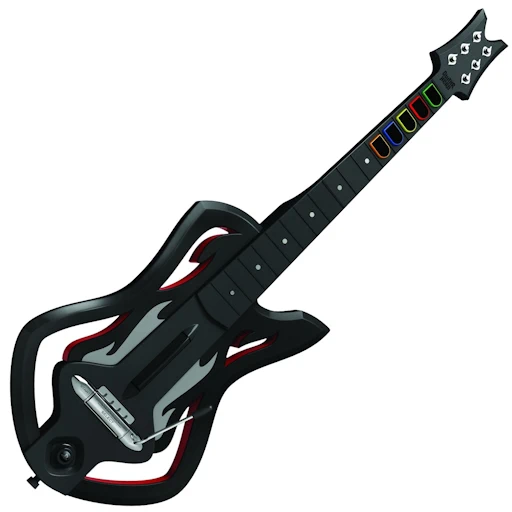
Guitar Hero: Warriors of Rock Controller
The Guitar Hero: Warriors of Rock guitar controller was introduced in 2010 alongside Guitar Hero: Warriors of Rock, the sixth main installment in the Guitar Hero series. Released for the Xbox 360, PlayStation 3, and Nintendo Wii, the controller represented one of the more unusual redesigns of the traditional Guitar Hero guitar. Rather than attempting to resemble a conventional real-world guitar, it featured an aggressive, fantasy-inspired appearance that complemented the game’s heavier rock theme.
The most distinctive feature of the Warriors of Rock controller is its removable guitar body. Unlike earlier Guitar Hero controllers that used interchangeable faceplates, most of the functional controller—including the fret buttons, strum bar, controls, and electronics—is concentrated in the central neck/core assembly. Removable plastic “wings” attach to the sides to form the guitar body, allowing different body designs to be installed. The controller can even be operated with the wings removed. This construction also eliminated the detachable neck connection found on several earlier Guitar Hero guitars.
One notable change from the World Tour and Guitar Hero 5 controllers is the removal of the touch-sensitive slider strip located farther down the neck. Instead, the Warriors of Rock controller returned to a more straightforward five-fret-button arrangement. The strum bar and other controls were also refined as part of the redesign.
Today, the Warriors of Rock controller is particularly easy to recognize because of its angular body, removable side wings, and compact central controller assembly. As with other Guitar Hero guitars, the exact connection method and compatibility depend upon the console version. Because the Warriors of Rock design was released near the end of the original Guitar Hero era, it is also one of the more distinctive—and increasingly collectible—official Guitar Hero controller designs.
| Game System | xBox 360 | Wii | PS2/3 | ||
|---|---|---|---|---|---|
| Guitar Model Number The model number is on a label either on the back of the guitar (most common) or in the battery compartment. | 96150.805 | 96158.805 | 96142.805 | ||
| Manufacturer The original manufacturer of the guitar controller. | Activision | ||||
| HobbyCNC Fretboard The compatible HobbyCNC fret board. | GH-10 | GH-08 | GH-10 | ||
| OEM fretboard number This is the original part number of the fret board as provided by the manufacturer. This can be on the top or bottom of the PC board, either printed or embedded in the copper. | RSF-3621-4-3 | 95055-KEY R1.3 | RSF-3621-4-3 | ||
| 3D Printed Fret Buttons Replacement 3d-printed fret buttons designed to work with this specific controller/game combination. | – | – | – | ||
| Neck silencer Adhesive foam pads laser-cut to fit this specific controller. | – | – | – | ||
| Whammy Repair Replacement for the most common cause of a ‘floppy’ non-working whammy bar. | Completely different design than all other GH Controllers | ||||
| Whammy Spring Replacement spring that returns the whammy bar to center. | Completely different design than all other GH Controllers | ||||
| Battery Cover 3D printed replacement battery cover | * | N/A | * | ||
| Neck Lock For use when the controller neck is ‘hard wired’ to the controller body preventing the neck from being removed on accident. | N/A One piece body | ||||
| Case Screws Screws used to secure the controller neck and body fronts-and-backs together. | M3x10_TORX | ||||
| PC Board Screws Screws used to secure the various circuit boards in the controller neck and body. | M2.3-8-PIL | ||||
| Strap Plug A count of the strap plug quantities and lengths. | * | * | * | ||
| Strum Switch The type of switch used on the strum controller board. | * | * | * | ||
| Dongle The required dongle for PS2 and PS3 game systems. | N/A | N/A | See Dongle Cross Reference Guide | ||

Every effort was made to ensure this information is accurate.
If you discover an error or a correction, please let me know through the Support Page.
An asterisk (*) indicates information is needed.